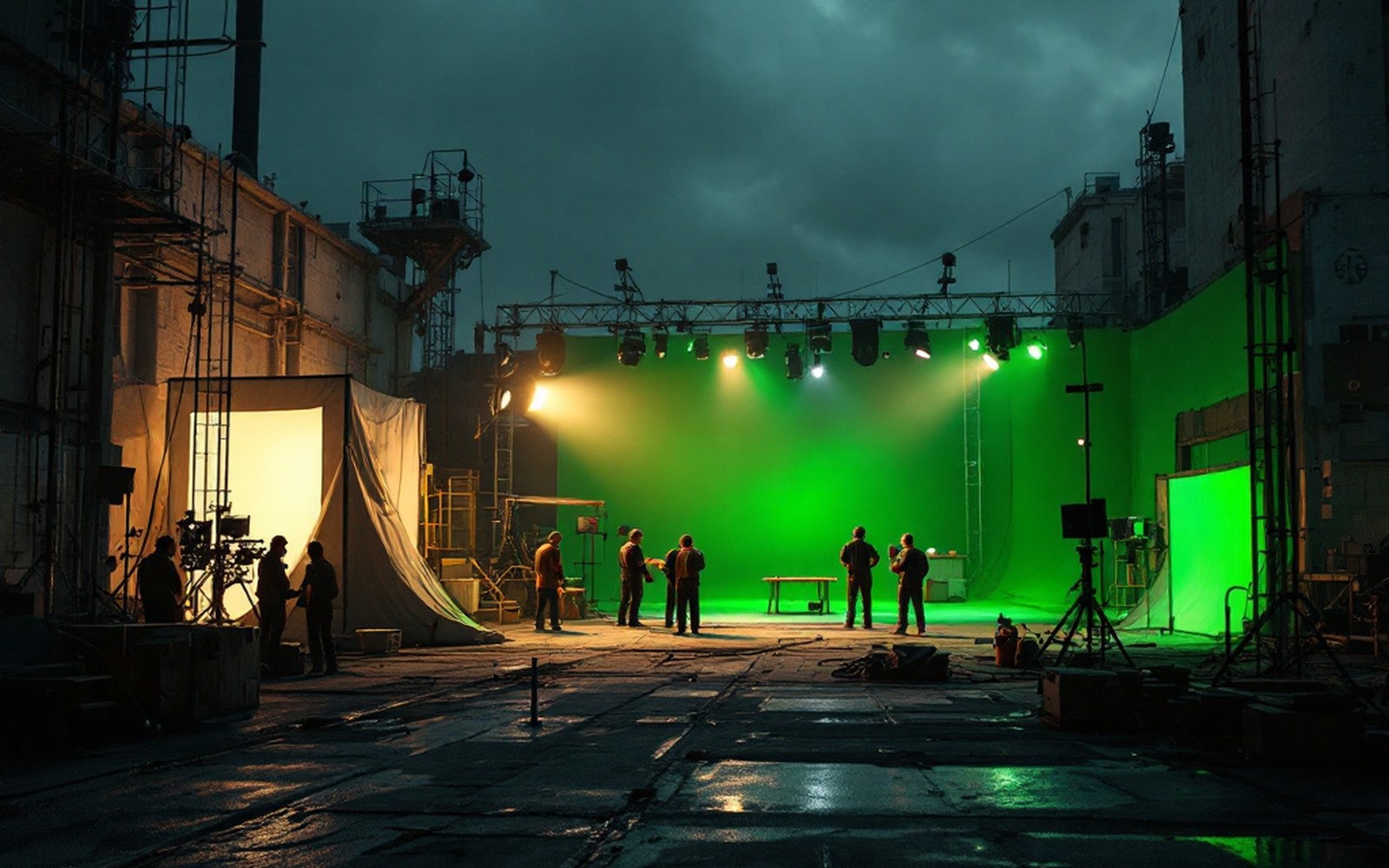
The ball has to behave, and it usually does not
A scripted piece of play has to be repeatable on camera, which is why the shot list is built around what can actually be delivered twenty times.

Why every football commercial is really a negotiation with physics
The brief arrives with a vision: a striker cuts inside, drops a shoulder, and bends a shot into the top corner — and it must happen from a precise angle, in a single take, at the right moment in the light. What the director of photography wants and what the ball can reliably do are almost never the same thing, and the gap between those two positions is where a football shoot actually lives.
The core problem is repeatability. A film production operates on repetition — the same action, twenty or thirty times, so the edit has coverage and the lighting team can adjust between takes. Actors can mark a spot and hold an expression on cue. A football struck at full pace cannot. It moves differently every time a different player takes the ball, and even the same player, asked to reproduce a specific trajectory, will deliver a distribution of results that clusters around the intended shape but never nails it identically twice. That distribution is what the shot list is actually built around: not the perfect outcome, but the most probable one.
Experienced commercial directors working with footballers understand this and design shots accordingly. A low, wide angle makes the ball's deviation less visible to camera. A tight lens on the player's face, cutting away before the ball lands, outsources the physics problem entirely to the edit. When Wieden+Kennedy built the airport film for Nike at the 1998 World Cup cycle, many of the skill sequences were shot in close-up precisely because full-frame ball control at camera speed requires an implausible number of clean takes to get one usable one.
The ball is in frame for less time than the viewer thinks. The edit does the rest, and that is not a cheat — it is the shot list being honest about what twenty takes will actually produce.
The shot that looks hardest is usually not the problem
Counterintuitively, the genuinely difficult shots are often the mundane ones. A clean header delivered to a precise area of frame is easier to set up than a natural-looking pass between two players at a conversational distance. Headers carry arc; the camera can sit at the apex and the ball arrives predictably. A flat pass three metres between players at close to match speed asks both players and the camera operator to be in exactly the right position at the same moment, and almost no player performs a three-metre pass with the instinctive concentration they bring to a header in front of goal.
Ball behaviour also varies with surface. Shoots staged on artificial pitches — chosen for weather reliability and visual consistency — produce a ball that skips differently than it would on a grass pitch in natural conditions. Some productions wet the surface for visual texture, which compounds the bounce unpredictability. The practical answer, used routinely, is to shoot the ball interaction and the player's face separately and cut between them, a technique that is invisible in the final film but constitutes most of what the second unit is doing while the main camera is on the star.
Speed is another variable that makes the camera's job harder than the director's brief suggests. At match pace, a well-struck ball travels fast enough that standard frame rates produce motion blur; higher frame rates sharpen the ball but alter the feel of the image in ways that then require visual effects work to reconcile. The FIFA partner tier spots that ran through the 2010 and 2014 cycles, both for broadcast and for the large-format stadium screens, were frequently shooting at higher frame rates for exactly this reason, with the grade adjusted in post to match the broadcast master.
The cleaner solution, where budget allows, is animation — which is why Nike's 2014 World Cup film dispensed with real ball physics altogether. When the schedule is tight and the playable window between tournament matches is counted in days, removing the ball-behaviour variable entirely is sometimes the most rational choice available. It also allows for exactly the trajectory and speed the story demands, which no amount of takes with a real leather ball can guarantee.
What separates the films that feel athletic from the ones that feel laboured is almost never how good the player is. It is how honestly the shot list was written in the first place — built around what the ball will actually do twenty times in two hours, rather than what it does in the best version of the brief.